 |
Evac
I |
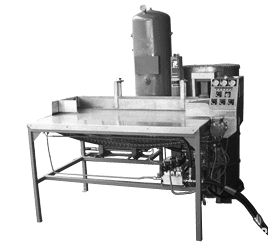
EVAC I AEROSOL CAN CRUSHER/RECOVERY SYSTEM
For the aerosol manufacturer and waste disposal firms, a means of dealing with reject aerosol cans safely and efficiently is critical. In addition, the contents must be handled and the can itself reduced. Workers must be protected and the VOCs contained to protect the environment.
HISTORY
Our Evac aerosol can crushers along with the Tube Taper and Aerosol Can Orienter/Labeler are in operation worldwide.
The Evac Aerosol Can Crusher Systems have been in use and refined for more than 30 years to safely and efficiently capture, enclose, and retain more than 95%+ of the entire contents for safe disposal or recycling.
SYSTEM DESCRIPTION
Aerosol cans are uprighted on an accumulating type Feed Table which feeds them to a compaction cylinder, hydraulically driven and sealed. Aerosol cans are crushed to about 1/2", and contents are collected under pressure and transferred to a pressure tank for safe disposal or recycling.
The system includes a 25 HP hydraulic unit with filtration, a heat exchanger, an automatic low oil / high temp shut-down and features air logic control of hydraulic valves.
A 15 cfm Vacuum Pump, surge tank and check valves remove any residual contents from crushed cans.
OPERATION
Cases of aerosol cans are opened on
the stainless portion of the table, cans uprighted and pushed onto the slow-moving
table-top chains, which transfers individual aerosol cans into the Pre-Loader
chamber. One chain section has a start-stop feature with each cycle; the other
three chains move slowly, continuously crowding the cans forward to the feed
chain. The Feed Table is powered from the EVAC hydraulic system. Aerosol cans
of varying diameters and lengths are randomly handled without the need for
changing or adjusting parts.
SEQUENCE OF OPERATION (see dwg #E2-OP1)
| 1. | Single aerosol cans are fed into Pre-Loader from Feed Table. |
| 2. | The Pre-Loader moves aerosol cans upright over piston head. |
| 3. | Can is lowered into hydraulically powered Compaction Cylinder. Seal cap moves into place, hermetically sealing can in the chamber. |
| 4. | As the piston rises, can ruptures and is crushed into a wafer 1/2" thick. The contents go through check valves in the piston, which close at the top of the stroke. |
| 5. | A vacuum scavenger system removes any propellant vapors and concentrate from around crushed can before the cylinder seal. This material is pumped into the pressure tank, called the primary receiver. |
| 6. | At pre-set amount of vacuum, the seal cap moves away and crushed can wafer is discharged into a well-ventilated "drying" conveyor which has its own drive, drain, and pump for further drainage and release of any remaining propellant. |
| 7. | The propellant and concentrate are forced into a pressure tank as the piston lowers the next can. |
| 8. | The crushed aerosol can wafer is discharged into customer's container for recycling. |
| 9. | An exhaust fan driven hydraulically, removes up to 2,500 cfm of air and vapors from the compaction cylinder enclosure and crushed can drying. Propellant from accidental spills are quickly exhausted and mixed with excess air for safety. The propellant can be removed as a gas or liquefied for use as a fuel, incinerated, or recycled. The concentrate can be pumped as a liquid without foaming problems to the appropriate disposal system or reused. |
HANDLING OF CONTENTS
The propellant and concentrate from aerosol cans are transferred to the primary receiver (pressure vessel). The propellant gas is lighter than the propellant liquid and the propellant liquid is usually lighter than the concentrate. Propellant can be drawn off as a gas using a pressure regulator to (1) be vented to atmosphere, (2) an open flare (thermal oxidizer), (3) to a furnace or boiler as a supplemental fuel, or (4) reliquefied for concentrated storage or transport. When the tank pressure is lowered to 3 psi or less, the concentrate can be transferred to standard barrels for handling to an appropriate disposal sites (heavy foams, such as mousse, shaving cream, rug cleaner, etc. no longer foam.)
Hydrocarbons can be reliquefied into a 250 lb. test tank. When full, it can be moved to a cement plant, for instance, and off-loaded into their bulk storage tanks.
EVAC ATMOSPHERIC PRESSURE
If propellants can be released to the atmosphere, low pressure tanks (barrels) can be substituted for high pressure tanks and the propellant directed into the exhaust fan for positive mixing with adequate air, for safety, as it is released.
PRIMARY RECEIVER
Must conform to local codes for hydrocarbon storage vessels with safety valve, etc. Size from 250 to 2500 gallons, depending upon operation. If concentrates are to be reused, several small tanks may be desirable.
VACUUM SYSTEM
This is a secondary scavenger function to pick up any residual propellant left in and around the crushed cans, before releasing the cans to atmospheric pressure. The tank is the surge so the vacuum can be performed in a minimum amount of time. A piston pump works continuously to hold a vacuum in a tank. The vacuum pump delivers this material into the main line to the pressure vessel.
CLEANING
Cleaning after use is recommended, using a solvent that effectively combines with the product being processed. Running the machine through 4 or 5 cycles with some solvent will clean the check valves, cylinder walls, etc. It is recommended that oil be left on all working surfaces when the machine is not in use.
ELECTRICS
Parts furnished explosion proof, Class 1, Group D: Pump motor (optional), heat exchanger and tank heater. The machine control is by air logic (no electricity) so it is explosion proof. Electricity required is about 40kw for the power unit.
EXCLUDED ITEMS
Plumbing, storage tank, vacuum tank, crushed can receptacle and any extensions to infeed and outfeed conveyors.
SYSTEM FEATURES & SPECS
| 1. | Hydraulic Power Unit with 25 HP TEFC motor, 20 gpm Hydura pump (plumbed and tested), and air to oil heat exchanger, low oil-hi temp safety sensors, and 2000 watt oil heater and filters. |
| 2. | Vacuum System, operated by power unit, with 6" ID chrome plated cylinder wall x 12" stroke, and with tank and valves to scavenge propellant vapors and concentrate from around crushed cans before releasing the compaction cylinder seal. |
| 3. | Compaction Cylinder, 4" ID Chrome plated x 10.5" stroke, powered by a 3.25" diameter heavy duty press cylinder, operating 6-10 cycles per minute depending upon type of product. |
| 4. | Pre-Loader, accepts single can and loads compaction cylinder. |
| 5. | Air Programmer with operator control panel, conveniently arranged for manual or automatic operation, with emergency stop and other safety features. |
| 6. | Feed Table, 36" X 60", with stainless top and plstic tabletop chain. |
| 7. | 20" Fan hydraulically driven, to remove 200-2500 cfm +/- of air and vapors from compaction cylinder enclosure. |
| 8. | Accomodates 202-300 can diameters X up to 10.5" heights. |
| 9. | *Electrical capacity: 15,000 watts / *Compressed air pressure: PSIG / *Compressed air volume: 5 cubic ft. per min. / *Hydraulic Power Pressure: 2500 PSIG |
Contact Us | Our Products | News | Profile | Sales | Environment | Site Map